
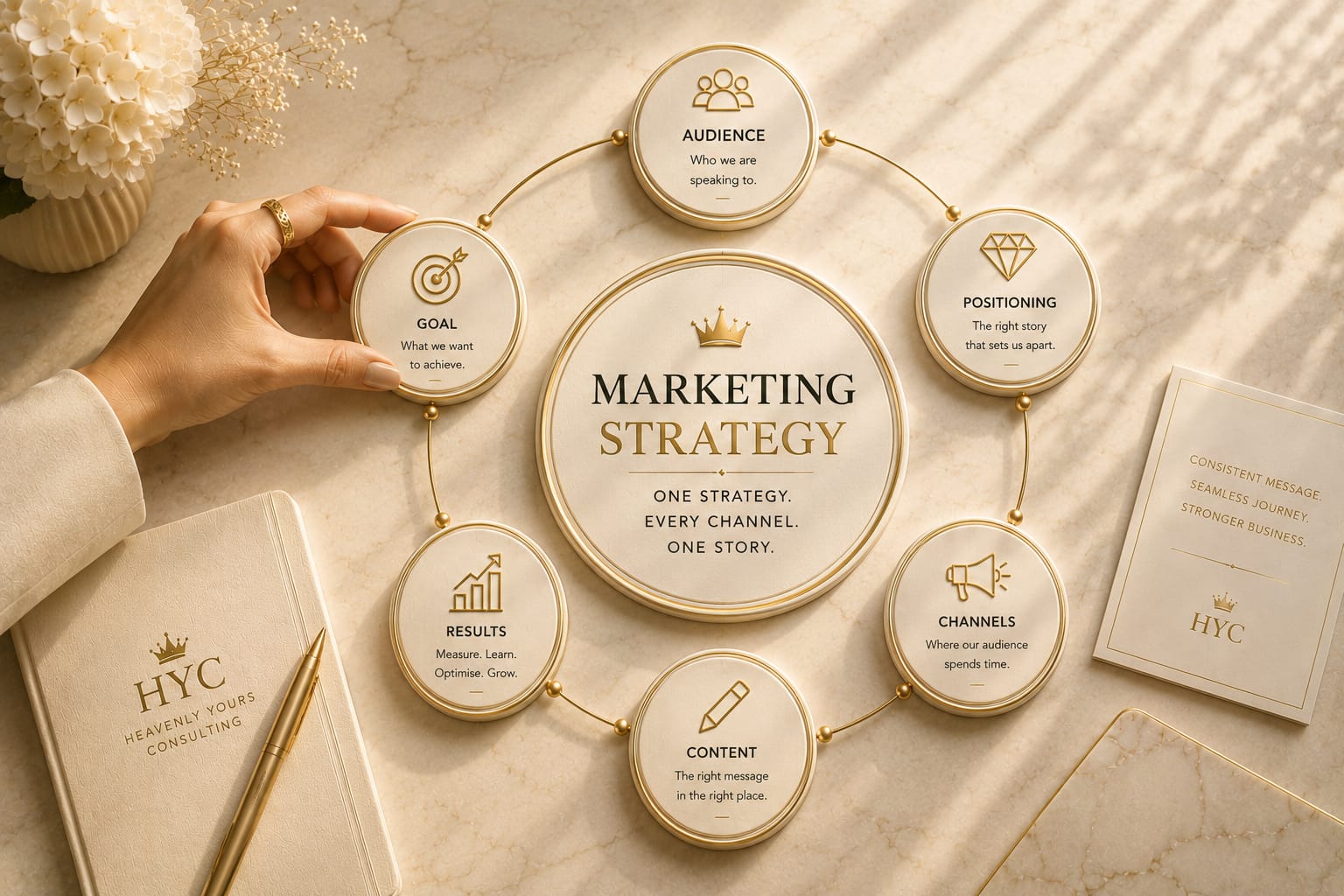
Most small hospitality businesses don’t have a marketing strategy. They have activity — a post here, a boosted advert there, a promotion when things are quiet. It feels busy, but it rarely builds anything. A strategy is what turns scattered activity into steady growth.
What a marketing strategy actually is
A marketing strategy is simply a plan that answers: who are we trying to reach, what do we want them to do, and how will every channel work together to make that happen. It’s not a 40-page document. For most businesses it fits on a single page.
The 5 parts of a simple strategy
1. Your goal. Be specific: more direct bookings, higher midweek occupancy, more covers on quiet nights. One or two goals, not ten.
2. Your audience. Who exactly are you for? The clearer the picture, the easier every other decision becomes.
3. Your positioning. The one thing that makes you the right choice for that audience. (This comes from your brand positioning — the foundation underneath the strategy.)
4. Your channels. Where your audience actually is — social media marketing, Google, OTAs, email — and what each one is for. Not every channel; the right ones.
5. Your rhythm. What you’ll publish and how often, so it’s consistent rather than whenever-you-remember.
The mistake to avoid
Don’t start with the channel (‘we need TikTok!’). Start with the goal and the audience, then let those decide the channels. A marketing strategy built the other way round — channel first — is how businesses end up busy on five platforms and growing on none.
Make it one connected story
The real power comes when every channel tells the same story. You write your core message once, then adapt it everywhere: a blog article becomes social posts, becomes a newsletter, becomes a press angle. Built once, used everywhere — consistent, efficient, and far more effective than starting from scratch each time.
Building this connected strategy — and then running it across every channel — is exactly what we do for hospitality businesses in Phuket, through our Signature Brand Blueprint and ongoing management.
Leave a Reply